On September 3rd, 2026 the Zimmermannhaus Brugg Kunst & Musik opened its doors for a soft opening of the show “still.life.” This art show by Steve Fors and Christoph Brünggel is scheduled to officially open on September 18th. For this soft opening, we were able to demonstrate the completed animatronic cecropia moths I worked on this year. The piece seemed to be well received by the audience and numerous attendees spoke with me to share their joys of gardening for insects and the enchanting entomology facts they knew.
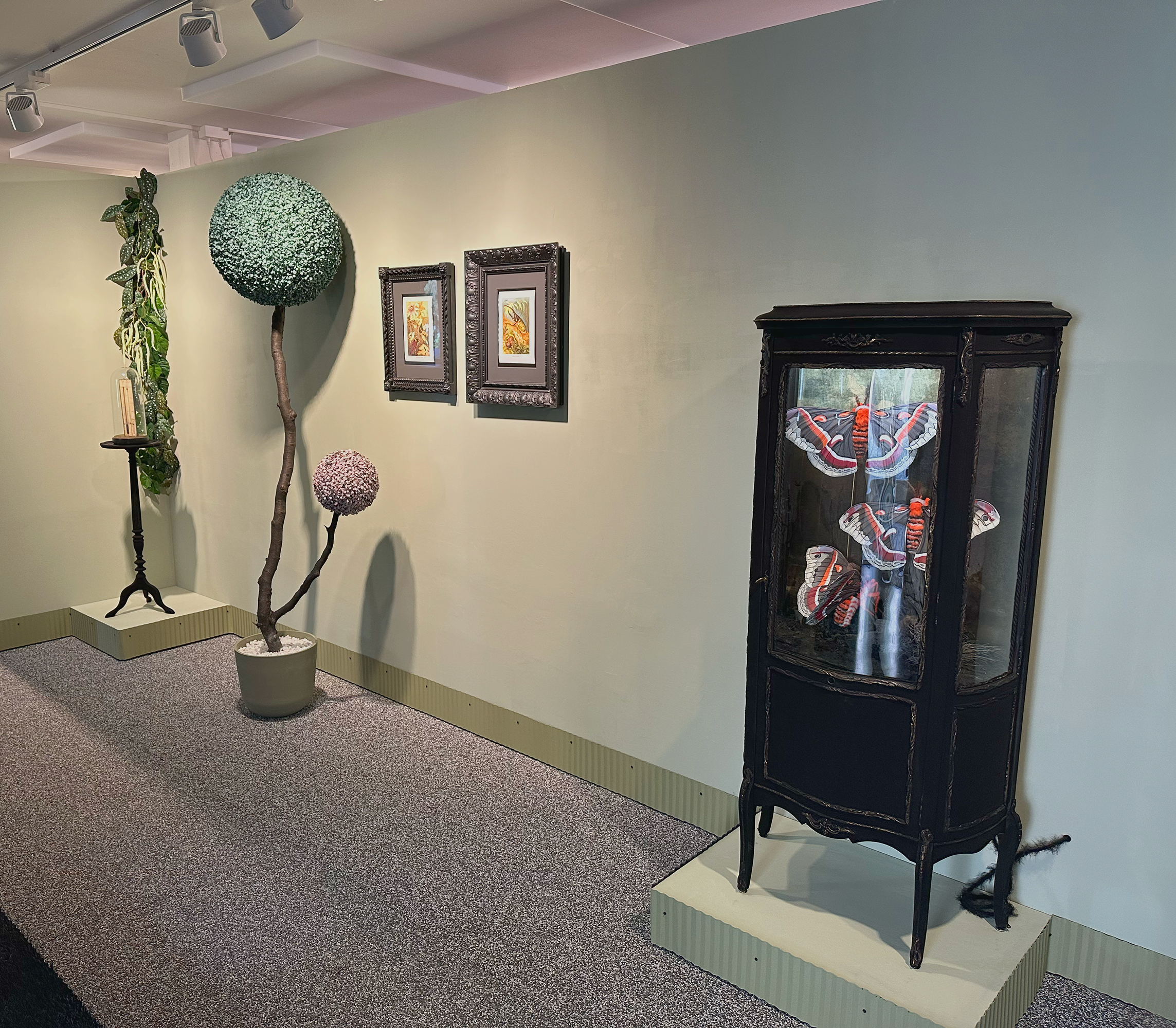
A preview of the still.life show opening on September 18th 2026 at the Zimmermannhaus Brugg Kunst & Musik. This show by Steve Fors and Christoph Brünggel features animatronic cecropia moths created by John Espey.
I previously wrote about my initial work to develop this animatronic sculpture. Since that blog article, I finalized the mechanism design and chose the cecropia moth as the species to mimic. Steve and I had discussed using this moth as the target species because he had a history of finding these moths living in the States and one of the prints he modified for the art show features the cecropia moth and other members of the Satruniidae family. Even though we have a similar but different species on the west coast, the ceanothus moth, I also found this moth species really exciting and the proportions worked well for this display.
Hyalophora cecropia is the species name for this moth. The name is in reference to Cecrops, the mythical greek half man, half snake. This is because the cecropia moth has false eyes on its wing tips. Researchers believe these eyes are meant to mimic a snake and spook birds and squirrels, deterring them from eating the moths. I find it particularly exciting that the moth is mimicking a snake. I am mimicking the moth in my sculpture and in mechanism design. Also of note, one of the moth’s predators is a spider which mimics the female pheromone to lure in the males and eat them. This mimicry is a kind of simulation, a major theme for the entire art show. Steve and Christoph produced work which simulates environmental sounds, smells, and sights.
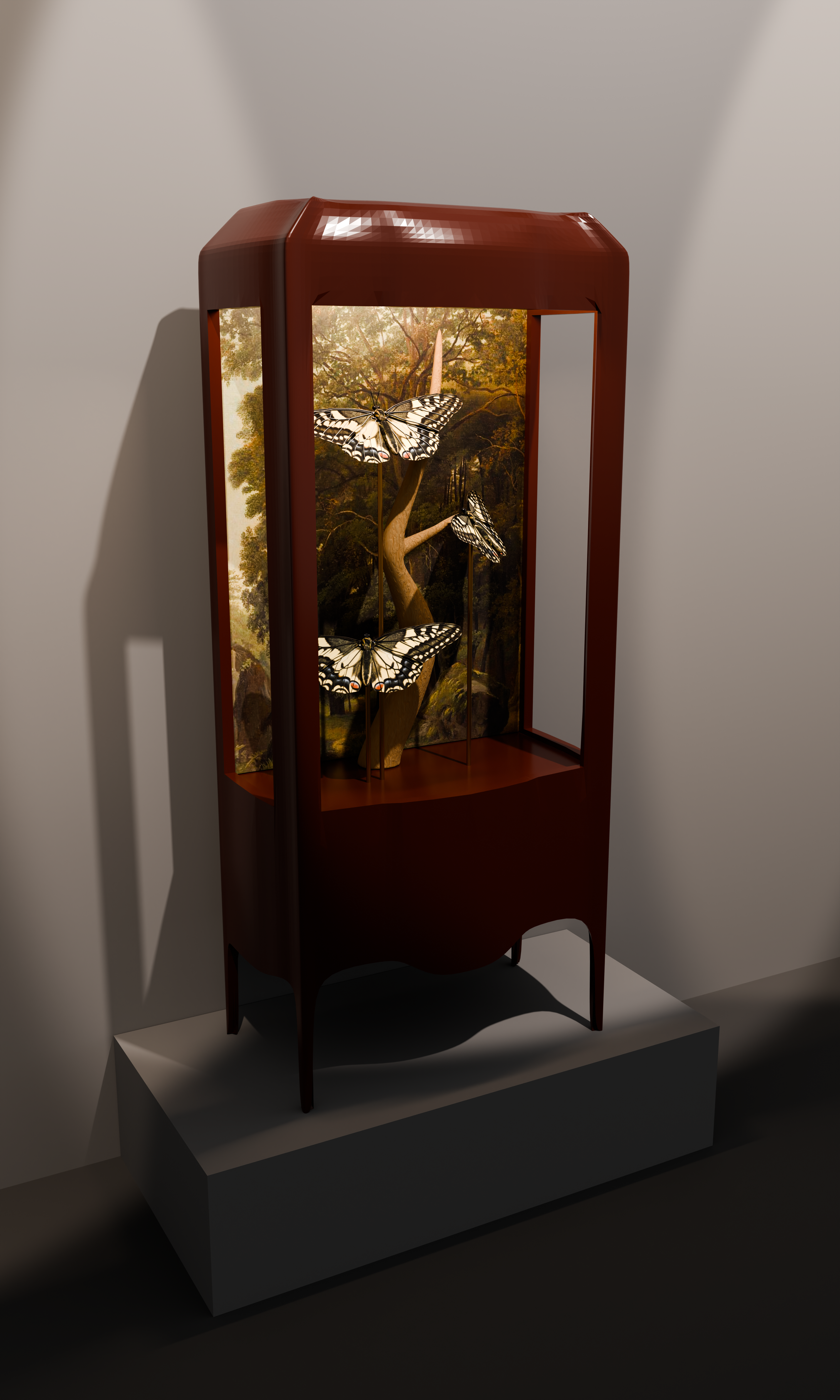
Refined concept render of the size and placement of the lepidopterans that I eventually changed to the cecropia moths. Pictured is a placeholder swallow tail butterfly, but we chose the cecropia moth for its use of mimicry and matches another piece in the still.life show.
The final production work happened in several stages. Once Steve acquired the vintage glass cabinet we would use for the art show, I had dimensional constraints to design the 3D model. I finished to completion one of three moths as a final proof of concept. I was able to use a relatively thin brass tube with another small teflon tube inside as the bowden tube mechanism. This allowed us to keep it quite subtle and hidden, giving the moths a lot of space to occupy. I leaned on Steve to locally source longer brass tubes that we could trim down on location. Also, we knew we wanted to include an interesting wooden branch to have each moth rest on. Thankfully this wooden branch acted as additional stability.
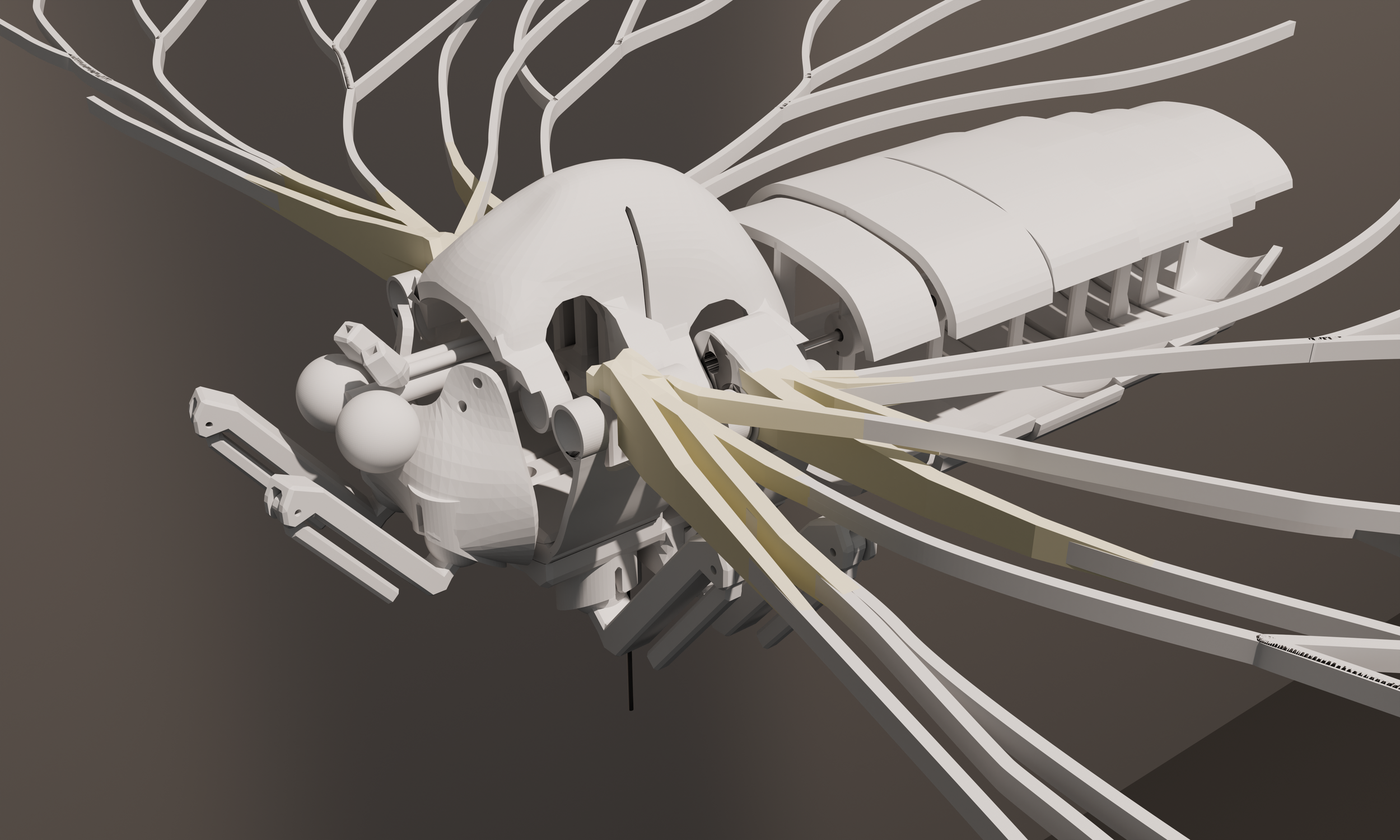
The final female 3D model of a cecropia moth with all of its sclerites which match real parts of the moth exoskeleton. I balanced the design between anatomical accuracy, feasibility for successful 3D printing, and robust mechanical action.
During that process I realized I had made the moth a male so I updated the design to make two more as females. For this species, the main differences between the sexes are that males have smaller abdomens and larger antennae. Otherwise, they are visually very similar. Producing the wings is one of my favorite tasks now that I have a reliable jig system. I also designed stencils so I could spray paint the colors onto the wings in a very reliable and symmetrical way. The most tedious task was gluing faux fur to each 3D printed sclerite of the exoskeleton. Fur material is quite messy and releases micro fibers everywhere. I also don’t enjoy the smells and stressors of glue, clamping and getting things accidentally stuck together. I think I would like to explore different materials and techniques to make fuzzy abdomens of insects in the future. Each time I produce an insect, some part of the insect also requires fly tying technique. For these moths, I used fly tying tools and materials to make the heads and tibias of the legs.
I wasn’t sure how much airport security would scrutinize my art, so I packed my electronic components and extra piano wire in my checked luggage. I brought the finished moths, which are almost entirely plastic, in my carry on. Nothing of concern from a flight safety standpoint. I purchased pretty high quality strong servos from a reliable vendor, Pololu. I also used their six channel maestro servo controller to program a movement sequence. At home, I soldered together all the electronics, tested everything, and created the initial program. On location, I finished the movement speed and rotation angles to match the enclosure space. Thankfully, I still had a draft program saved on my old windows laptop that I was able to quickly update specifically for this project. I think it is great that there is some legacy and carry over from my Kidzeum installation in this project!
In the end, the entire process went very smoothly. I methodically placed and installed all the major components over a few days and we were able to make small tweaks to improve it at each step. The only thing I was worried about was the joining peg between the thorax and the brass tubes. It is a very thin PLA plastic hollow insert that the entire moth has to rest on. I strategized a backup plan for this if it failed, but in the end I didn’t need it because the full layered assembly and supporting wooden branch keeps the moth in position quite well. Even with the wings flapping a lot during the evening, the moths stay in position and the wings don’t bump into the sides of the cabinet. I think the joining peg had more strength because it is a layer of piano wire, teflon tube, PLA sleeve, inside the brass tube. It all works together to stay pretty strong.
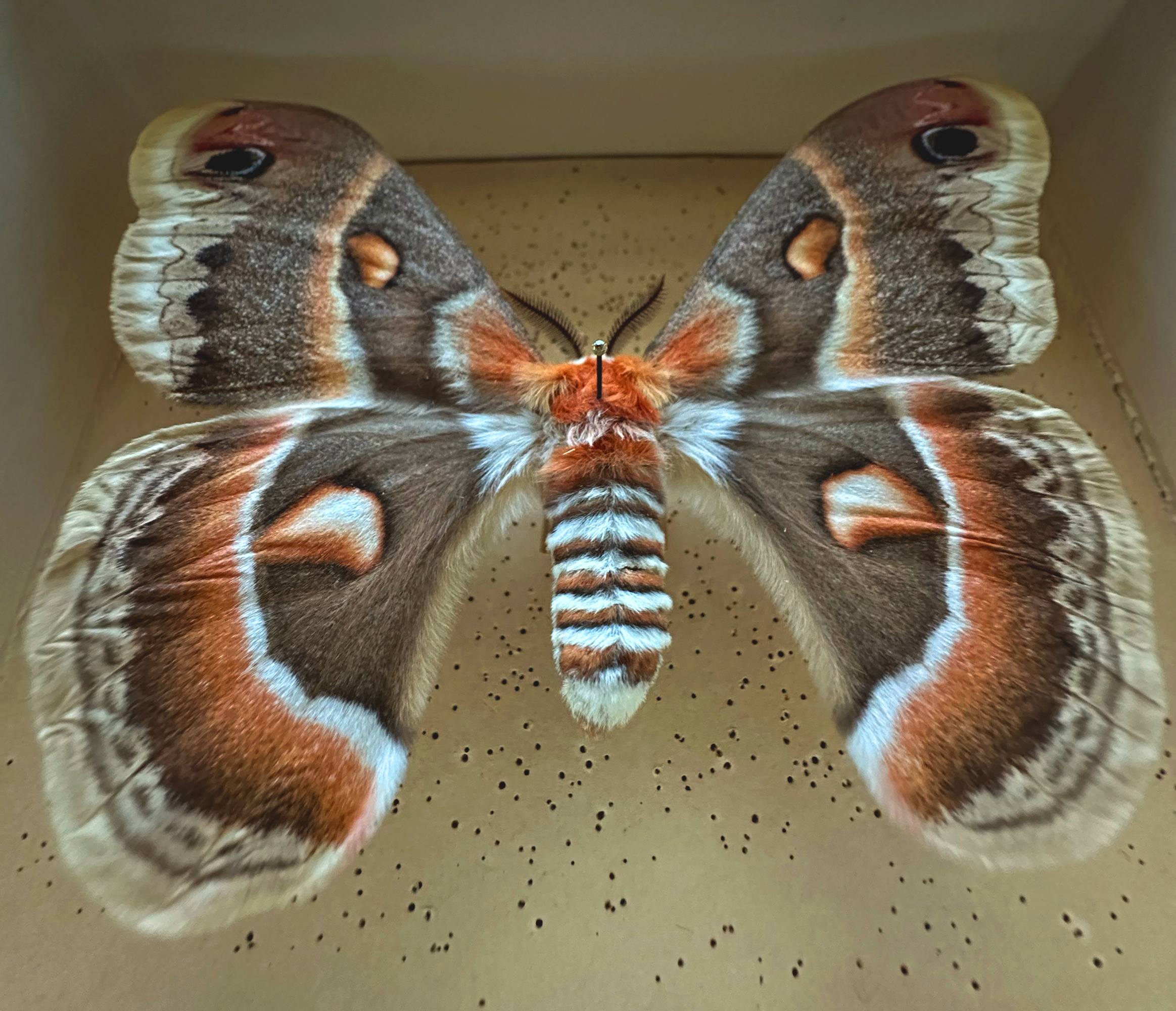
Real pinned cecropia moth. This is likely a male from its very long antennae.
The next day Steve and I toured the entomology collection of ETH Zurich. We got to hang out with Michael Greef and he showed us their nifty 3D imaging device as well as their extensive collection of insects. Some of their insects are extinct, and it is a weird feeling to see a thing which will never be created by the world ever again. As part of this tour, we got to examine their cecropia moths!
I am just so honored and humbled by the generosity and openness of all of the artists and people I have met and worked with on this project and my trip to Zurich. I can’t thank everyone involved enough for including me in this art show. I hope to use the energy of these accomplishments to kick off the next projects. For instance, I heard about this project called Antscan. It is a free database of extremely accurate ant 3D models. I can’t wait to load one up in blender and elevate the accuracy of my creations.