I am excited to share that I have been invited to participate and collaborate in an upcoming exhibition currently titled “still.life” in Switzerland! I am honored to have been asked to participate and I have been steadily working on designs and prototypes. The exhibition will open in September of 2026, at the Zimmermannhaus Brugg Kunst & Musik (https://zimmermannhaus.ch). Leading the exhibition and gracefully taking a chance on working with me is artist Steve Fors. Steve’s vision for the multi-room gallery experience is topical and enchanting with some very cool interdisciplinary art pieces in development. With only a few months remaining, I want to use as much of the time as possible to develop the highest quality animatronics I can.
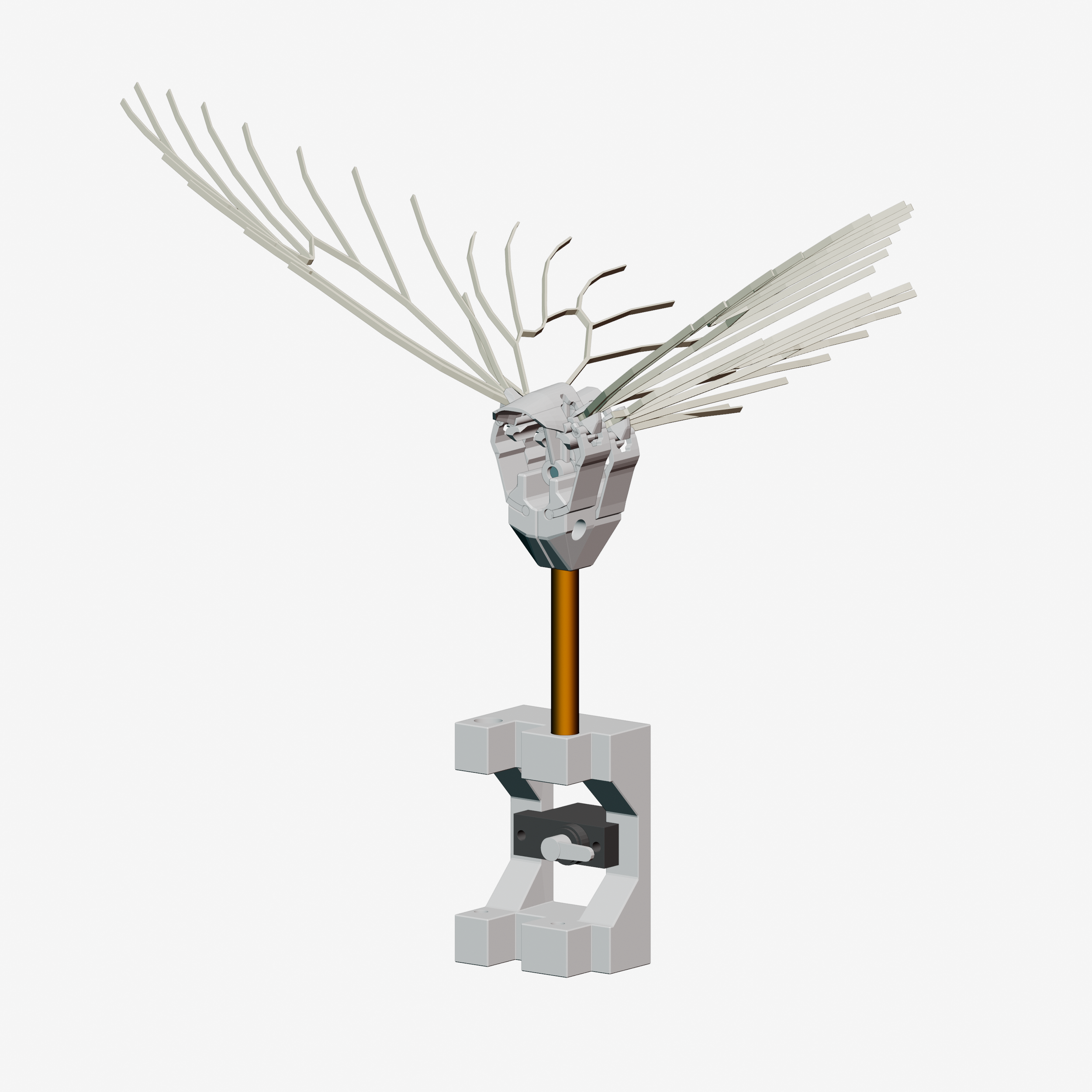
Render of the prototype thorax mechanism for my animatronic lepidoptera. Servo rotation is transmitted through the Bowden cable into the thorax and rotates the two pairs of wings.
My plan is to create three animatronic lepidopterans displayed in a vintage glass cabinet. These will feature my techniques for wing production and insectoid textures to create realistic moths and butterflies that flap their wings in diverse ways. A motion activated electronic sensor will trigger a wing behavior. At the moment, I think I will be using an infrared human motion detector to trigger preset servo movements. Right now, I am finalizing my mechanism design which will be the platform I can customize to create each unique moth or butterfly. At the base, the servo pushes and pulls on a stiff piano wire that is connected to thoracic components. Rotational motion of the servo is translated to linear motion, transmitted through the Bowden cable, and then translated back to rotation in the wing hinges. I am 3D printing the components with PLA, but I may upgrade them to a professionally printed stiffer or sturdier material after the design is finalized.
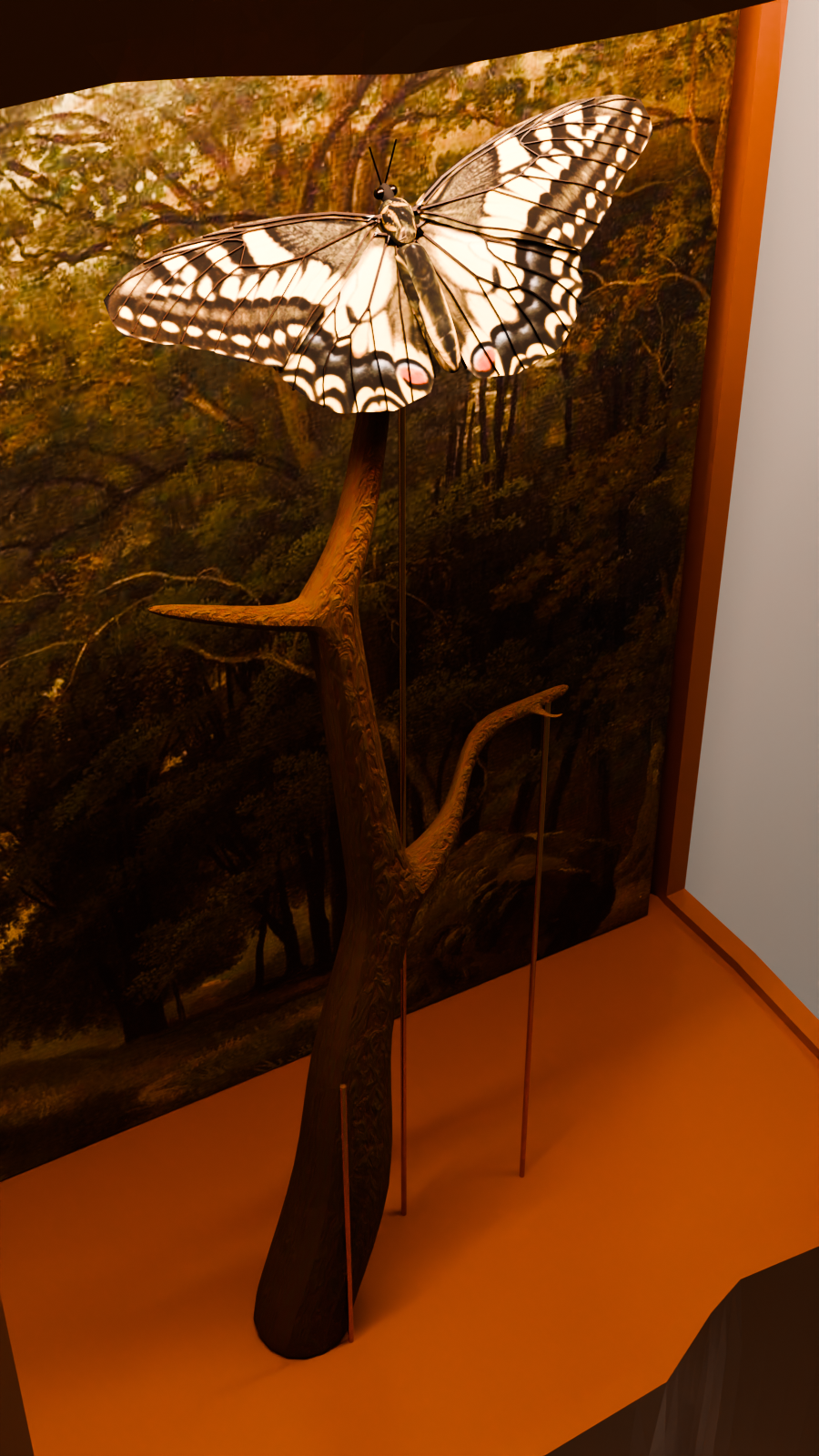
Concept render of an animatronic lepidoptera in a vintage glass cabinet. The final piece should have three moths or butterflies, and the motors and electronics will be hidden in the base. The motion will be triggered by some kind of sensor responding to a viewer approaching the cabinet.
I learned a lot from my monarch commission at the Kidzeum years ago. The new challenge is to reduce the size of my animatronics and make the mechanisms as robust as possible. Instead of embedding servos in the thorax, I’ll need to transmit the force and motion of the servos through Bowden tubes/cables. I will also need to study new species of moths and customize each animatronic to match the body shape and wing profiles of these different species. Finally, I will deliver these animatronic creations to Switzerland, which is somewhat more involved than staying here in the United States.
This project has already helped me develop as an artist. The design of the thorax is heavily influenced by real insect flight mechanisms. The wings terminate at the edges of the thorax and pivot around a pleural wing process. The force is exerted on the wings by my own version of a scutum and scutellum. As a result, I am able to achieve large wing stroke angles, and I can avoid bulky gears. I am doing this so that after I decorate the objects with textiles and paint, the components of the mechanism will sell the illusion of real insect sclerites in addition to having educational value.
If I needed any more in my life than this fantastic opportunity, I have also become connected with a community of artists and engineers that periodically share their projects around themes of biomimetics and interdisciplinary crafts. In June, I will give a short presentation of my art and I look forward to connecting with this audience that appreciates insects and building things. The year 2026 is promising to be a great year for me! Not since 2019 have I felt so excited to create and share. As a sort of spiritual cherry on top of these amazing events, I found two living butterflies on the ground and I was able to pick them up and move them to safer places. The first was a monarch which appeared in my yard one chilly evening and I was able to hold it for a moment before placing it in some mugwort to rest. It was still there the next morning, but after warming up in the sun, it flew away. I hope it just needed a safe place to sleep and found what it needed the next day. The second butterfly was a west coast lady butterfly, and I found it on the floor at my office. It likely flew in through our open skylight. I was able to take it outside under a tree in hopes that it was still healthy, just lost. I don’t tend to put too much weight on coincidences, but I must admit this all feels spiritually significant.
Unless I write again sooner, hopefully my next blog entry is a wrap up and reflection of installing my animatronic moths in Switzerland! Huge thanks to Steve Fors for reaching out and trusting me to contribute to this project.